



7-pin 24 V connector, type N — the basic lighting functions: position lights, brake lights and indicators. These are the 7PIN type N plugs in our 24V catalogue.
Standards you can see in the connector
Quality in vehicle electrical connections is not a marketing line. It is a set of tests, dimensions and requirements that have to hold in every batch.
ISO 4091
Electrical connectors for vehicles
ISO 4091 sets out the tests and quality requirements for electrical connectors used between vehicles. It covers every connector used for that purpose and is detailed further in the related standards below.
- ISO 1185
- ISO 1724
- ISO 3731
- ISO 3732
- ISO 7638-1 / ISO 7638-2
- ISO 11446
- ISO 12098
The individual standards
What each one covers
ISO 4091 says how a connector is to be tested. The standards below say what it must look like — how many pins, what voltage, which function on which contact. They decide whether a plug from our production will fit a socket on the other side of the drawbar.
7-pin 24 V connector, type S — supplementary functions, among them the reversing light and auxiliary power. In the catalogue, the 7PIN type S plugs.
7-pin 12 V connector, type N. The standard for light and agricultural trailers — the socket you meet most often in Europe.
7-pin 12 V connector, type S — adds the supplementary functions to the one above, fitted as a second socket.
13-pin 12 V connector. It gathers the functions of both 7-pin sockets into one, which is why it is replacing the N + S pair on newer vehicles.
15-pin 24 V connector for truck combinations. The 24V catalogue holds both 15PIN plugs and adapters onto two 7-pin sockets.
Power supply and control for ABS and EBS braking systems. Version -1 covers 24 V installations, version -2 covers 12 V. These are the connectors that must never be confused with the lighting ones.
In practice
Where the standard meets the production line
Conformity does not come from a declaration; it comes from what happens on the line. Four things we do on every series.
The same pin, the same function
The order of the cores and the function assigned to each contact follow the standard, not an assembler's habit. That is why our plug fits any manufacturer's socket.
Cross-section as documented
The standard sets minimum core cross-sections for each function. A cable thinner than required will work at idle and fail under load — so we verify the cross-section rather than assume it.
Sealing and life in motion
Vehicle connectors work in water, salt and vibration. Seals, overmoulding and bend radii are chosen so the product survives a winter season, not just the goods inspection.
Repeatability between batches
The second and the tenth batch have to match the first. We record the parameters of each series, so an order repeated a year later hits the same dimensions.
Documentation
Need it confirmed in writing?
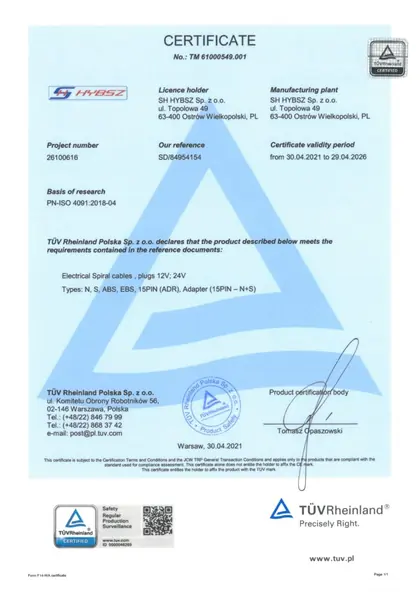
For series orders we issue documentation confirming the product parameters. If your quality department needs a particular set of data — cross-sections, materials, temperature range, batch marking — tell us before production starts. It is easier to plan than to reconstruct afterwards.
Ask about documentationWhat to tell us
- The standard the product must conform to
- System voltage: 12 V or 24 V
- Number of pins and connector type
- Operating conditions: temperature, salt, oils
- Whether batch marking is required